


 PLoS ONE | www.plosone.org


Info
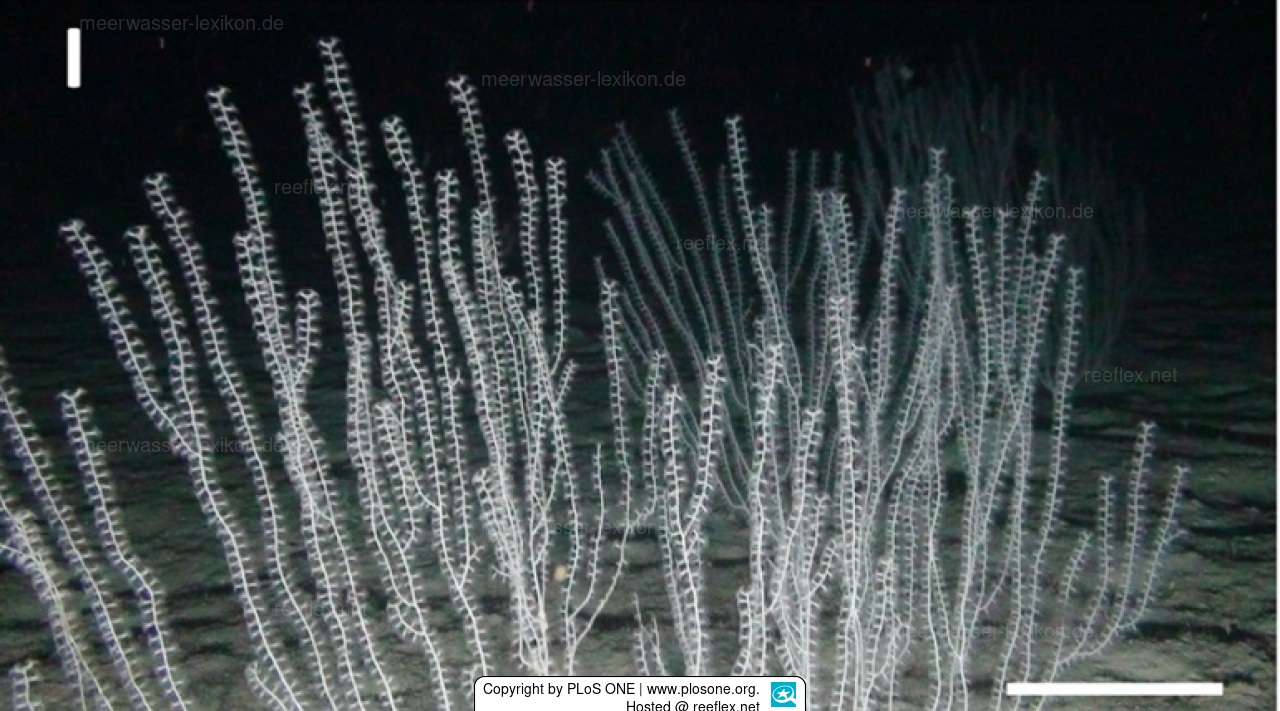
Isidella elongata bildet Kolonien aus, deren Wuchsform an einen kandelaberförmign Kerzenleuchter erinnert.
Diese Bambuskoralle kommt bis in sehr große Tiefen von über 1,5 Kilometer vor, wo nur noch Dunkelheit herrscht, dort sind auch keine fotosynthetischen Aktivitäten mit Zooxanthellen mehr möglich.
Folglich müssen Tiefseekorallen ihre Lebensenergie durch den Fang von Plankton und Meeresschnee decken, je dichter die Wuchsform aus Stämmen, Ästen und Polypen sind, desto erfolgreichen können sich diese Arten etablieren.
Im Mittelmeer wurden Bestände der Koralle nur auf extrem-schlammigen Böden gefunden.
Das Smithionian National Museum of Natural History Institut gibt neben dem Mittelmeer eine Fundmeldung aus Zentralamerika (Honduras) an, die aus dem Jahr 1957 stammen.
Für tropisch-warme Heimaquarien nicht geeignet!
Synonyme:
Acanella giglioti Cecchini, 1914
Acanella mediterranea Cecchini, 1914
Isis neapolitana Koch, 1887
Diese Bambuskoralle kommt bis in sehr große Tiefen von über 1,5 Kilometer vor, wo nur noch Dunkelheit herrscht, dort sind auch keine fotosynthetischen Aktivitäten mit Zooxanthellen mehr möglich.
Folglich müssen Tiefseekorallen ihre Lebensenergie durch den Fang von Plankton und Meeresschnee decken, je dichter die Wuchsform aus Stämmen, Ästen und Polypen sind, desto erfolgreichen können sich diese Arten etablieren.
Im Mittelmeer wurden Bestände der Koralle nur auf extrem-schlammigen Böden gefunden.
Das Smithionian National Museum of Natural History Institut gibt neben dem Mittelmeer eine Fundmeldung aus Zentralamerika (Honduras) an, die aus dem Jahr 1957 stammen.
Für tropisch-warme Heimaquarien nicht geeignet!
Synonyme:
Acanella giglioti Cecchini, 1914
Acanella mediterranea Cecchini, 1914
Isis neapolitana Koch, 1887

