


 Kary Mar

Info
Stomozoa roseola (Millar, 1955)
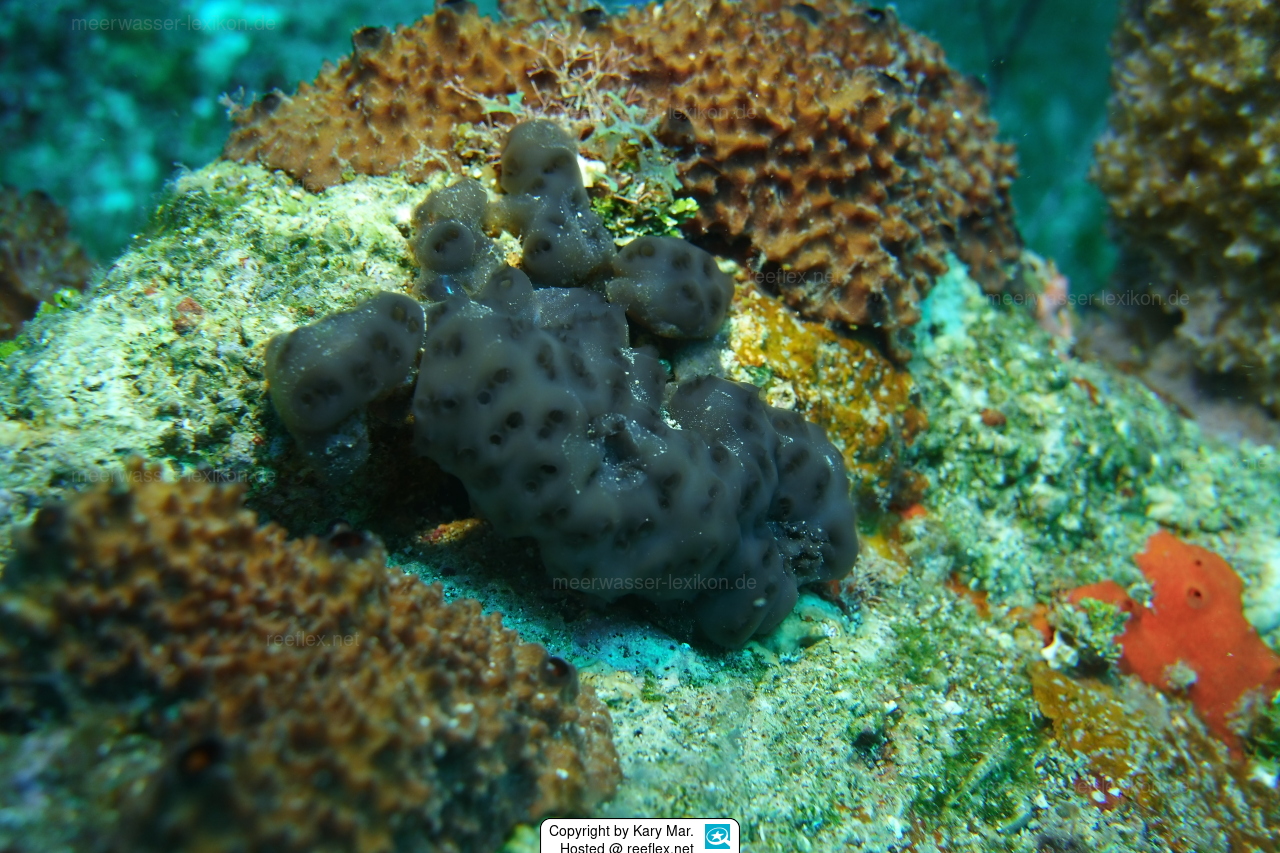
Stomozoa roseola forms large, hard, spherical or oval, cartilaginous and opaque colonies with holes on the surface for siphon openings .
Colonies from the Gulf of Mexico have been found on dead coral and among large rocks.The tunic is very firm and dark purple, similar to colonies from the Red Sea and Madagascar.The individual white colored zooids can grow up to 1.7cm long, and the zooid chambers are darker than the rest of the tunica.
Bacteria of the genus Acinetobacter sp. and the copepod Pachypygus stomozoae Kim I.H. & Boxshall, 2020 live in symbiosis on and with the sea squirt colony.
Etymology - From Neo-Latin roseola, from the diminutive of Latin rosa ("a rose"). Note: The colony remains pink in formalin with brown siphon openings.
Synonymised names
Stomozoa murrayi Kott, 1957 · unaccepted (junior synonym)
Note: Based on the photos provided, we are not certain whether the identification of the sea squirt is correct.
In the original descriptions of the species and its synonym, the color is described as “pink” when preserved in formalin; see also the species name “roseola.”
In the article “Checklist of ascidians (Chordata, Tunicata) from the southern Gulf of Mexico,” the color is described as “dark purple,” which is closer to what is shown in the photos.


