


 The University of Chicago Press


Info
Alatina alata belongs to the cube jellyfish and feeds predatorily on zooplankton, which it captures with the help of its long tentacles and the cnidocytes located there, and kills extremely quickly.
Cube jellyfish kill more people each year than sharks, rays, and sea snakes combined; about 100 people die each year from stings by the jellyfish.
The venom of the box jellyfish is produced by structures in the post-Golgi vesicles of the nematocysts.
When the tentacles come into contact with prey or potential predators, a cocktail of venom is rapidly released from the nematocysts via a long spiny tube, immobilizing the target organism.
Most cube jellyfish live in coastal waters, but Alatina is unusual in that specimens have also been collected in the open ocean at great depths.
Alatina is notable in that populations form monthly aggregations to mate in conjunction with the lunar cycle.
Encounters between humans and this cube jellyfish result in very, very painful and burning injuries for the bather or swimmer as batteries of cnidocytes inject a highly potent cytotoxin into human skin.
While no deaths have yet been reported from this type of cube jellyfish, affected skin areas should be cooled as soon as possible and doused with diluted vinegar.
It is strongly recommended that a physician be consulted for extensive injuries.
Combined molecular and morphological analysis of the venomous ear jellyfish Alatina alata suggests that glandular cells are found in the gastric cirri that may play a dual role in the secretion of toxins and toxin-like enzymes.
These putative glandular cells could be important both internally (prey digestion) and externally (poisoning) in cubozoans.
Despite the absence of nematocysts in the gastric cirrus of mature Alatina alata medusae, this area of the digestive system appears to be the region of the body where toxin-implicating gene products are found in abundance, challenging the notion that in cnidarians toxin is synthesized exclusively in or near nematocysts.
Brief description:
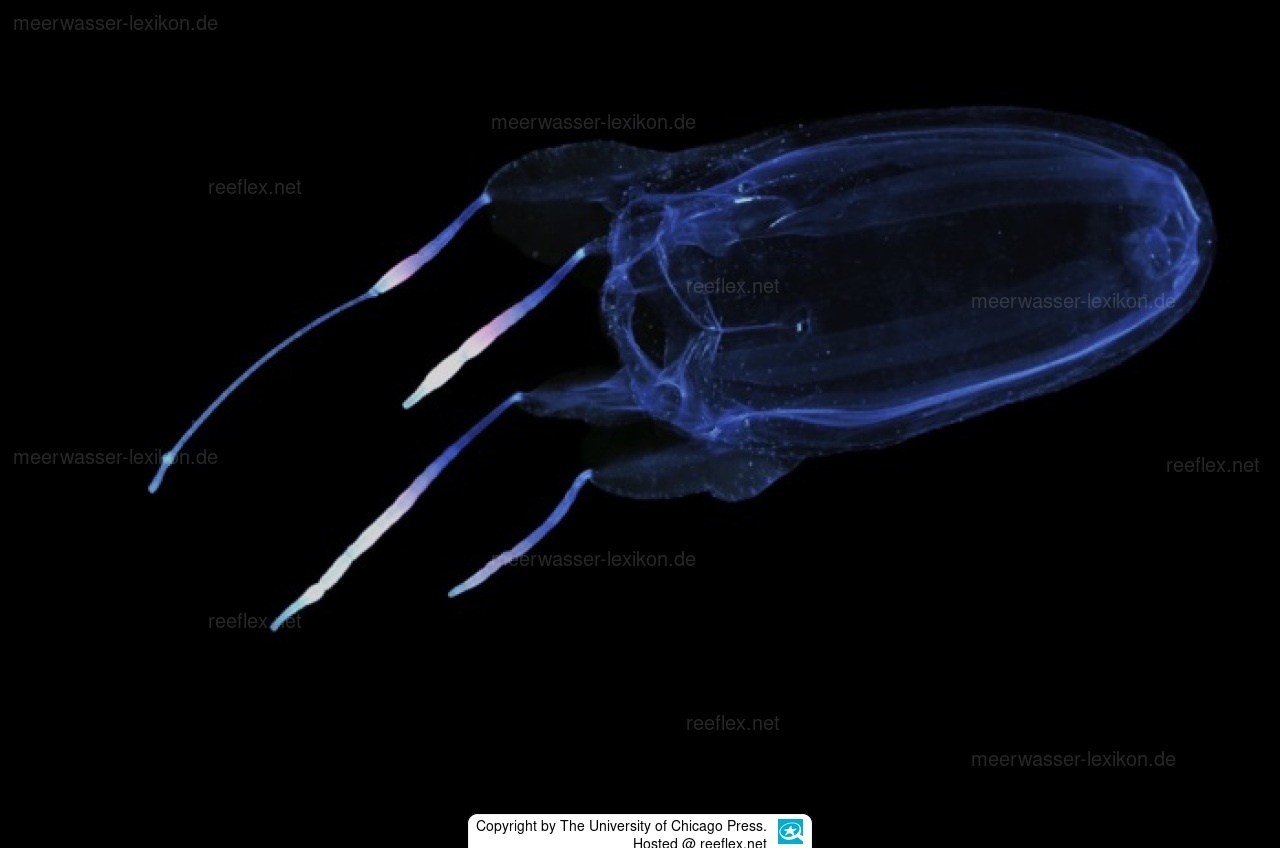
Height to 25 cm, width 1/3 to 1/2 of height. Bell thick, translucent, with smooth surface and four long tentacles, pinkish-yellow banded.
Four T-shaped pits, dull ocher, located more than 1/4 up from bell edge. Gastral cirri in small groups in gastral corners.
Ocelli brownish-black.
Alatina alata is a strong swimmer, occasionally swarming.
Habitat: occasionally coastal. Distribution: pantropical.
Synonyms:
Alatina mordens Gershwin, 2005.
Alatina moseri (Mayer, 1906)
Carybdea alata Reynaud, 1830
Carybdea moseri Mayer, 1906
Tamoya punctata Fewkes, 1883
Cube jellyfish kill more people each year than sharks, rays, and sea snakes combined; about 100 people die each year from stings by the jellyfish.
The venom of the box jellyfish is produced by structures in the post-Golgi vesicles of the nematocysts.
When the tentacles come into contact with prey or potential predators, a cocktail of venom is rapidly released from the nematocysts via a long spiny tube, immobilizing the target organism.
Most cube jellyfish live in coastal waters, but Alatina is unusual in that specimens have also been collected in the open ocean at great depths.
Alatina is notable in that populations form monthly aggregations to mate in conjunction with the lunar cycle.
Encounters between humans and this cube jellyfish result in very, very painful and burning injuries for the bather or swimmer as batteries of cnidocytes inject a highly potent cytotoxin into human skin.
While no deaths have yet been reported from this type of cube jellyfish, affected skin areas should be cooled as soon as possible and doused with diluted vinegar.
It is strongly recommended that a physician be consulted for extensive injuries.
Combined molecular and morphological analysis of the venomous ear jellyfish Alatina alata suggests that glandular cells are found in the gastric cirri that may play a dual role in the secretion of toxins and toxin-like enzymes.
These putative glandular cells could be important both internally (prey digestion) and externally (poisoning) in cubozoans.
Despite the absence of nematocysts in the gastric cirrus of mature Alatina alata medusae, this area of the digestive system appears to be the region of the body where toxin-implicating gene products are found in abundance, challenging the notion that in cnidarians toxin is synthesized exclusively in or near nematocysts.
Brief description:
Height to 25 cm, width 1/3 to 1/2 of height. Bell thick, translucent, with smooth surface and four long tentacles, pinkish-yellow banded.
Four T-shaped pits, dull ocher, located more than 1/4 up from bell edge. Gastral cirri in small groups in gastral corners.
Ocelli brownish-black.
Alatina alata is a strong swimmer, occasionally swarming.
Habitat: occasionally coastal. Distribution: pantropical.
Synonyms:
Alatina mordens Gershwin, 2005.
Alatina moseri (Mayer, 1906)
Carybdea alata Reynaud, 1830
Carybdea moseri Mayer, 1906
Tamoya punctata Fewkes, 1883

