




 Gabriel Paladino Ibáñez, Uruguay


Info
Bassina disjecta (Perry, 1811)
Bassina disjecta is a mussel from the family Veneridae, colloquially known as clams. Members of the family have rounded to triangular shells, are often monochromatic, and have a prominent lunula ("little moon") in front of the whorl. Clams usually dig in the sand. They are found worldwide in warm and temperate seas, sometimes in estuaries. There are also edible species in the large family.
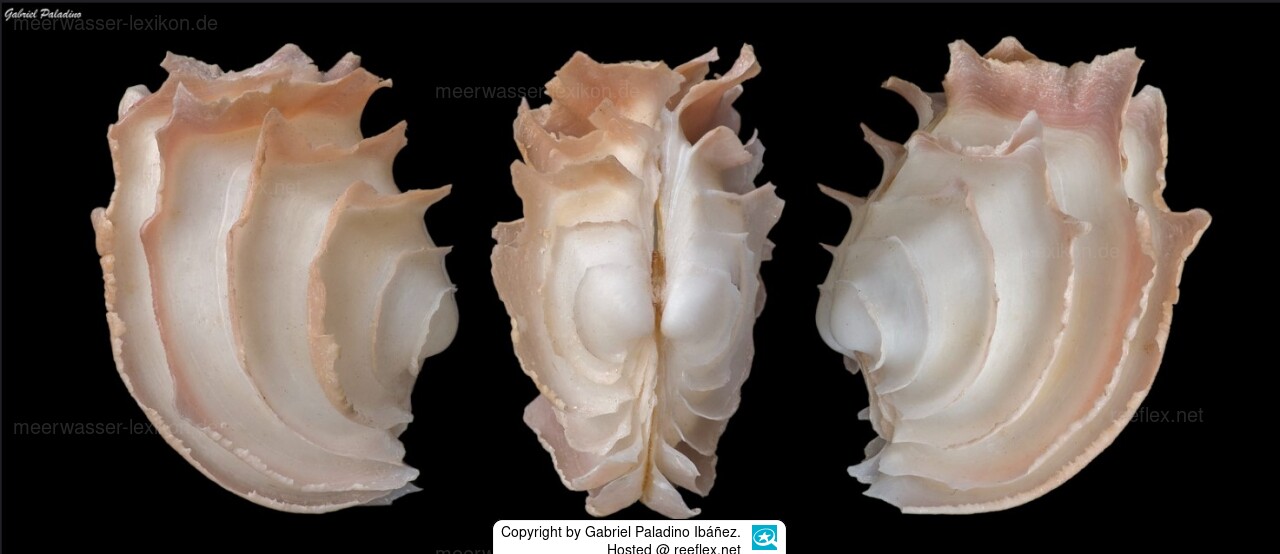
Bassina disjecta was described by George Perry in 1811. The approximately 6-7 cm large mussel with the distinctive shell sculpture lives on and in sandy and muddy soils, on coarse sand, on soft substrates in protected bays at depths of 4-40m. Funnily enough, the shell, colloquially known as the “Wedding Cake Venus,” is endemic to Australia. The name results from the tiered sculpture similar to a multi-tiered wedding cake. One source gives South Australia.
Characteristic of the shell is the very strong concentric sculpture of bent-back thin scales (lamellae) that extend over the entire length of the shell. The external color of the shell is deep cream with pink spots. The inside of the shell is white.
The mussel's predators are sea snails from the family Naticidae (moon snails) and Muricidae (spiny snails), starfish and fish.
Synonymised names
Bassina (Callanaitis) disjecta (Perry, 1811) · alternate representation
Circomphalus disjectus (Perry, 1811) · unaccepted
Venus disjecta Perry, 1811 · unaccepted (original combination)
Venus lamellata Lamarck, 1818 · unaccepted
Bassina disjecta is a mussel from the family Veneridae, colloquially known as clams. Members of the family have rounded to triangular shells, are often monochromatic, and have a prominent lunula ("little moon") in front of the whorl. Clams usually dig in the sand. They are found worldwide in warm and temperate seas, sometimes in estuaries. There are also edible species in the large family.
Bassina disjecta was described by George Perry in 1811. The approximately 6-7 cm large mussel with the distinctive shell sculpture lives on and in sandy and muddy soils, on coarse sand, on soft substrates in protected bays at depths of 4-40m. Funnily enough, the shell, colloquially known as the “Wedding Cake Venus,” is endemic to Australia. The name results from the tiered sculpture similar to a multi-tiered wedding cake. One source gives South Australia.
Characteristic of the shell is the very strong concentric sculpture of bent-back thin scales (lamellae) that extend over the entire length of the shell. The external color of the shell is deep cream with pink spots. The inside of the shell is white.
The mussel's predators are sea snails from the family Naticidae (moon snails) and Muricidae (spiny snails), starfish and fish.
Synonymised names
Bassina (Callanaitis) disjecta (Perry, 1811) · alternate representation
Circomphalus disjectus (Perry, 1811) · unaccepted
Venus disjecta Perry, 1811 · unaccepted (original combination)
Venus lamellata Lamarck, 1818 · unaccepted

