



 Franca Wermuth, Schweiz


Info
Sakuraeolis marhe Fernández-Simón & Moles, 2023
Type locality is Sunny Reef, Faafu, Maldives, 20 m depth.
Etymology: This species is named in reference to the MaRHE Center and its employees for logistics and their on-site assistance.
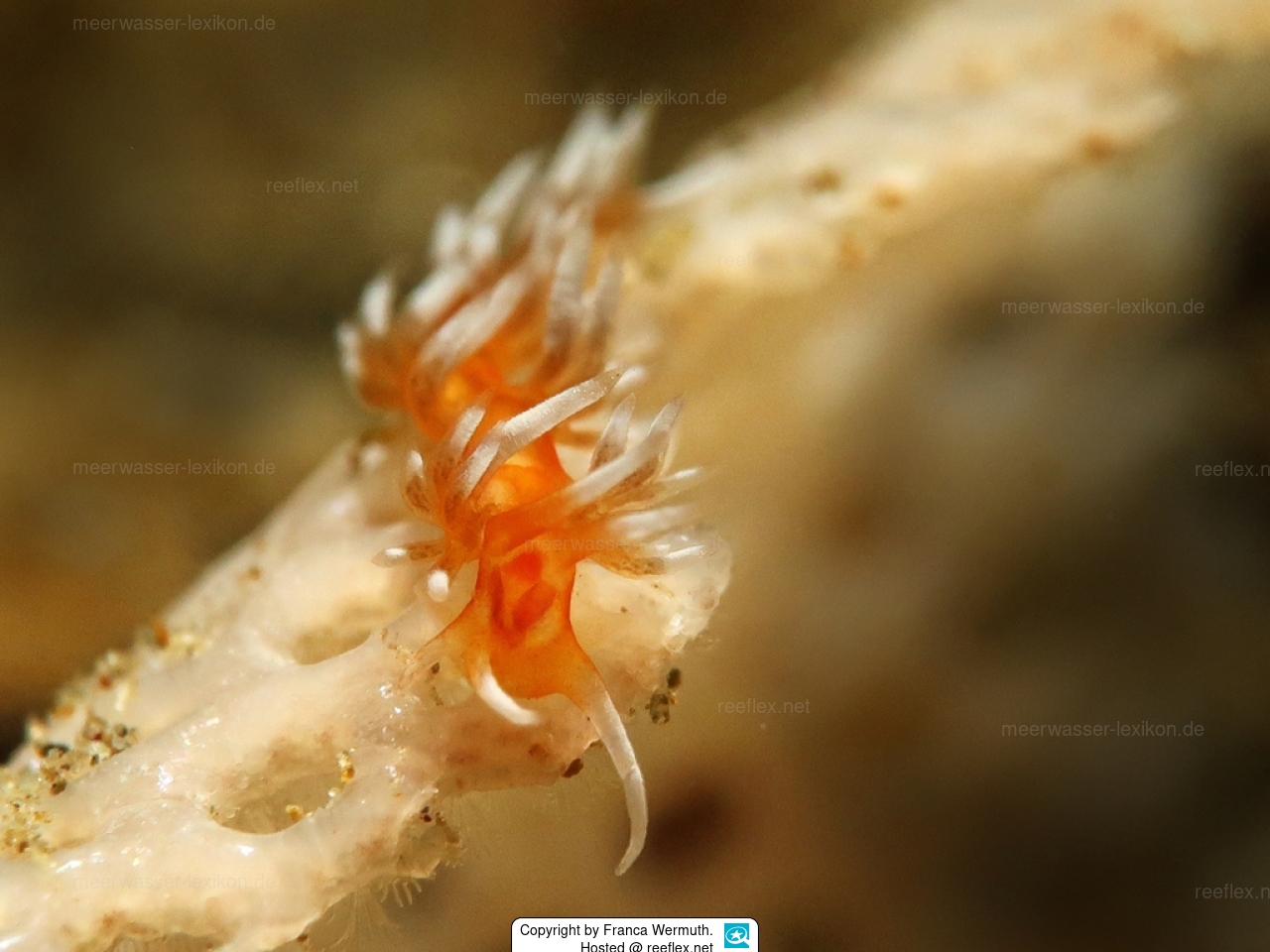
Description: Body bright orange or slightly paler; Tail milky white. The upper half of the mouth tentacles and the upper third of the rhinophores and cerata are milky white, opaque or slightly translucent. Rhinophores and mouth tentacles are conical and smooth. The cerata are arranged in four horseshoe-shaped clusters, the first in front of the pericardium, slightly separated from the rest; four per cluster side, innermost longer, upper third white; sometimes elongated nettle sacs, recognizable by their transparency.
At the time of description in 2023, the MaRHE thread snail is only known from the Maldives and the Philippines
Ecology: The three specimens were found on an encrusted bryozoan, which lives in symbiosis with hydrozoans on which it feeds (hydrozoa).
Sakuraeolis marhe feeds on Zanclea sp. associated with Celleporaria sp.
Note: Sakuraeolis marhe resembles one called Facelina sp.8 * called thread snail, but morphological study and molecular data suggest a relationship with Sakuraeolis. Diagnostic features of the genus Sakuraeolis such as: B. smooth rhinophores and horseshoe-shaped cerate clusters are present in Sakuraeolis marhe.
*Facelina sp. 8, Terrence Gosliner, Ángel Valdés and David Behrens. (2018). Nudibranch and Sea Slug Identification Indo-Pacific 2nd Edition. New World Pubns Inc.
Type locality is Sunny Reef, Faafu, Maldives, 20 m depth.
Etymology: This species is named in reference to the MaRHE Center and its employees for logistics and their on-site assistance.
Description: Body bright orange or slightly paler; Tail milky white. The upper half of the mouth tentacles and the upper third of the rhinophores and cerata are milky white, opaque or slightly translucent. Rhinophores and mouth tentacles are conical and smooth. The cerata are arranged in four horseshoe-shaped clusters, the first in front of the pericardium, slightly separated from the rest; four per cluster side, innermost longer, upper third white; sometimes elongated nettle sacs, recognizable by their transparency.
At the time of description in 2023, the MaRHE thread snail is only known from the Maldives and the Philippines
Ecology: The three specimens were found on an encrusted bryozoan, which lives in symbiosis with hydrozoans on which it feeds (hydrozoa).
Sakuraeolis marhe feeds on Zanclea sp. associated with Celleporaria sp.
Note: Sakuraeolis marhe resembles one called Facelina sp.8 * called thread snail, but morphological study and molecular data suggest a relationship with Sakuraeolis. Diagnostic features of the genus Sakuraeolis such as: B. smooth rhinophores and horseshoe-shaped cerate clusters are present in Sakuraeolis marhe.
*Facelina sp. 8, Terrence Gosliner, Ángel Valdés and David Behrens. (2018). Nudibranch and Sea Slug Identification Indo-Pacific 2nd Edition. New World Pubns Inc.


