




 ResearchGate


Info
Living sea sponges of this species grow irregularly massive and form conical to columnar bodies.
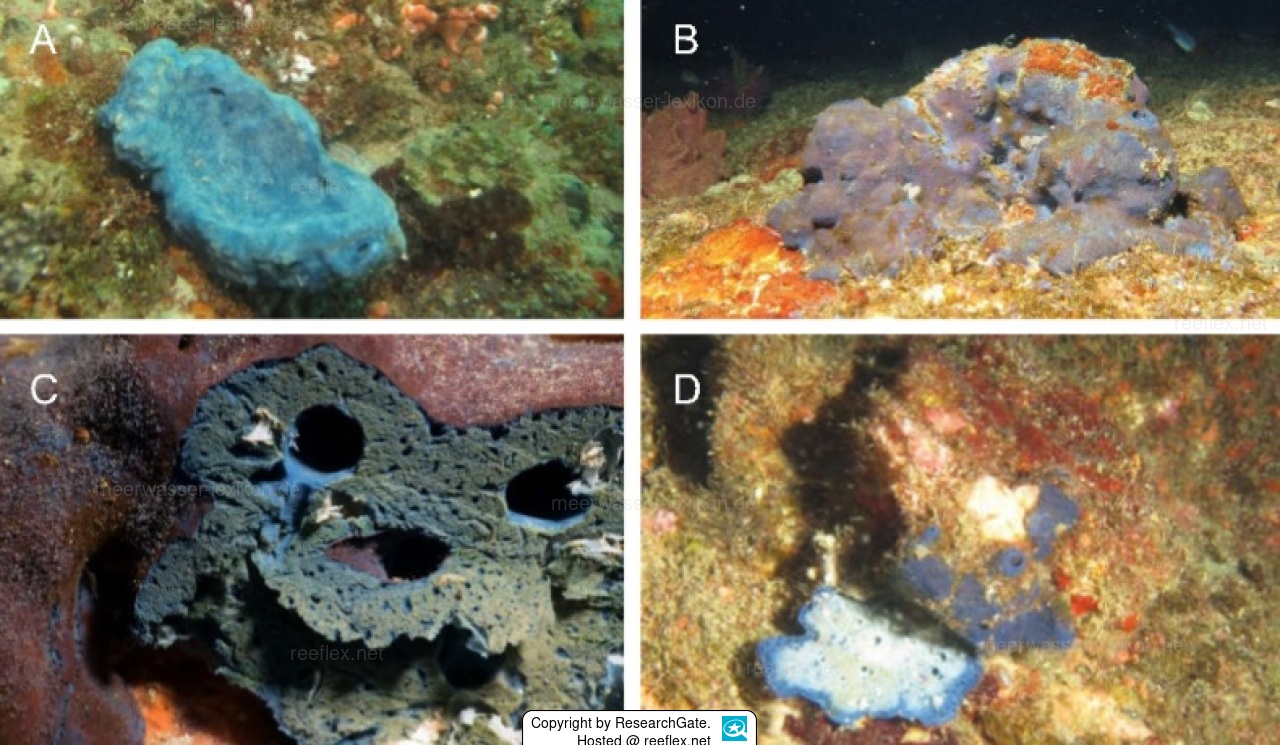
The color of Theonella timmi is light or bright blue to brown; the surface is often covered by epibionts that hide the superficial sponge color.
The specimens preserved in alcohol are beige with a greenish tint
The surface is uneven, the consistency is tough and non-compressible.
This sponge is widespread in Mozambique, it matches the species Theonella timmi, described in 2019 from South Africa, as it is colored blue both inside and outside, and by the shape and size of its spicules.
The surface is smooth with slightly raised, irregularly distributed oval oscules 2-5 mm in diameter; the sea sponge has a firm texture, velvety to the touch, non-compressible, difficult to break.
Inside Theonella timmi is soft, blue inside and beige in preservatives.
Habitat: The sea sponge has been found on rocky outcrops in open reefs exposed to currents.
Etymology.
The species was named after the late Peter Timm of Triton Diving for his discovery of the coelacanth off Sodwana Bay, his passion for marine research, his friendship and his logistical and technical support with our collections.
The color of Theonella timmi is light or bright blue to brown; the surface is often covered by epibionts that hide the superficial sponge color.
The specimens preserved in alcohol are beige with a greenish tint
The surface is uneven, the consistency is tough and non-compressible.
This sponge is widespread in Mozambique, it matches the species Theonella timmi, described in 2019 from South Africa, as it is colored blue both inside and outside, and by the shape and size of its spicules.
The surface is smooth with slightly raised, irregularly distributed oval oscules 2-5 mm in diameter; the sea sponge has a firm texture, velvety to the touch, non-compressible, difficult to break.
Inside Theonella timmi is soft, blue inside and beige in preservatives.
Habitat: The sea sponge has been found on rocky outcrops in open reefs exposed to currents.
Etymology.
The species was named after the late Peter Timm of Triton Diving for his discovery of the coelacanth off Sodwana Bay, his passion for marine research, his friendship and his logistical and technical support with our collections.

