


 Wiley Online Library


Info
Anthomastus tongi is a small azooxanthellate soft coral that is currently only known to occur on the M6 seamount on the Caroline Ridge in the tropical northwest Pacific.
At the site where the coral was found, at a depth of 790 meters, the water temperature was approximately 5.1 °Celsius.
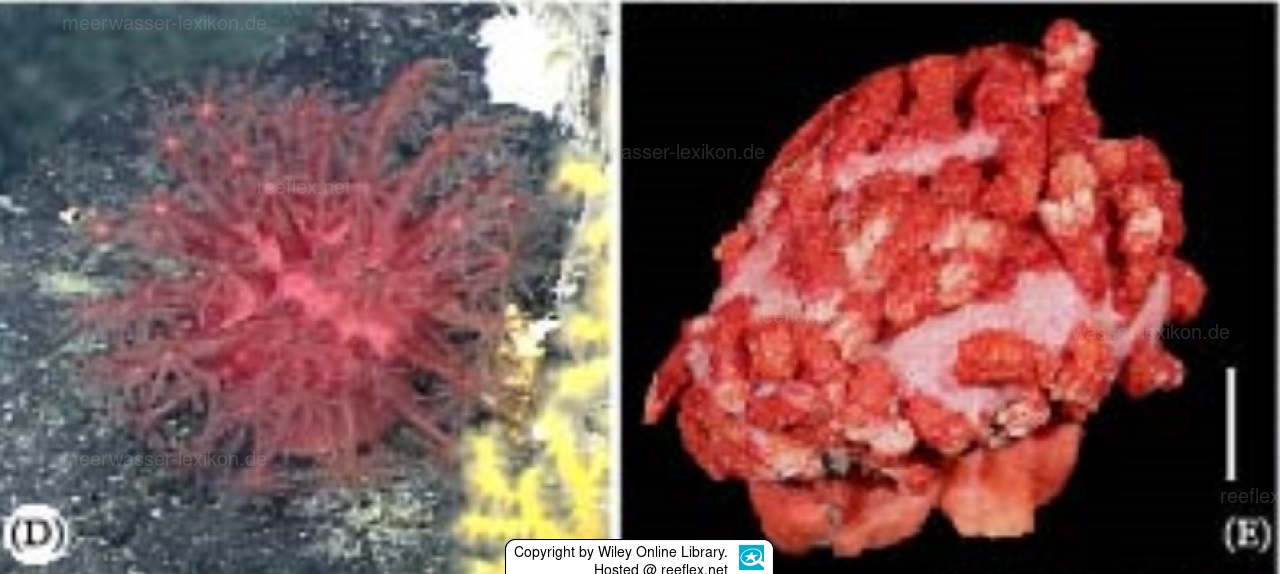
When alive, the soft coral adhered to a hard substrate, with the autozooids spread out and the pinnules visible.
The colony was hemispherical, 4.2 mm long, with a short stalk about 14 mm long and about 22 mm in diameter, arising from a membranous, spreading adhesive disc.
The capitulum protruded from the stalk, was almost spherical, about 42 mm in diameter and 28 mm long (occupying 67% of the total length of the colony) and bore 90 autozooids.
The polyps of Anthomastus tongi are dimorphic, the autozooids are evenly distributed over the capitulum, not retracted.
The autozooids were up to 15 mm long and 6 mm wide, the tentacles up to 4 mm long with more than 20 pairs of pinnules.
The siphonozooids are inconspicuous and scattered among the autozooids, measuring 0.2–0.3 mm.
Color: The colonies are red both when alive and after preservation.
Etymology:
The species name “tongi” was named in honor of the distinguished Chinese biologist Dizhou Tong (1902–1979), who received great recognition for his contributions to experimental embryology and cloning technology in China.
Literature reference:
Yang Li, Junyuan Li, Kuidong Xu
March 30, 2025 https://doi.org/10.1155/jzs/4177670
Mushroom Soft Corals (Octocorallia: Coralliidae) From Seamounts in the Tropical Northwestern Pacific: Morphology and Phylogenetic Analysis Reveal a New Genus and Six New Species
https://doi.org/10.1155/jzs/4177670
CC BY 4.0
At the site where the coral was found, at a depth of 790 meters, the water temperature was approximately 5.1 °Celsius.
When alive, the soft coral adhered to a hard substrate, with the autozooids spread out and the pinnules visible.
The colony was hemispherical, 4.2 mm long, with a short stalk about 14 mm long and about 22 mm in diameter, arising from a membranous, spreading adhesive disc.
The capitulum protruded from the stalk, was almost spherical, about 42 mm in diameter and 28 mm long (occupying 67% of the total length of the colony) and bore 90 autozooids.
The polyps of Anthomastus tongi are dimorphic, the autozooids are evenly distributed over the capitulum, not retracted.
The autozooids were up to 15 mm long and 6 mm wide, the tentacles up to 4 mm long with more than 20 pairs of pinnules.
The siphonozooids are inconspicuous and scattered among the autozooids, measuring 0.2–0.3 mm.
Color: The colonies are red both when alive and after preservation.
Etymology:
The species name “tongi” was named in honor of the distinguished Chinese biologist Dizhou Tong (1902–1979), who received great recognition for his contributions to experimental embryology and cloning technology in China.
Literature reference:
Yang Li, Junyuan Li, Kuidong Xu
March 30, 2025 https://doi.org/10.1155/jzs/4177670
Mushroom Soft Corals (Octocorallia: Coralliidae) From Seamounts in the Tropical Northwestern Pacific: Morphology and Phylogenetic Analysis Reveal a New Genus and Six New Species
https://doi.org/10.1155/jzs/4177670
CC BY 4.0

