


 iNaturalist Open Source Software


Info
As predicted by fluid dynamics, the filtration rate of a sponge increases with the size of the osculum area (i.e., the cross-sectional area of the outflow siphon) (Morganti et al., 2021)—and its filtration capacity can be enormous.
For example, a 1-kg loggerhead sponge (Speciospongia vesparium) can filter 24,000 liters of water daily (Vogel, 1994) or 50,000 times its tissue volume (Reiswig, 1971), removing 6% of the DOM in seawater in the process (Letourneau et al., 2020).
Spheciospongia vesparium is one of the marine sponges with the highest biomass of all sponge species in the waters around Florida, and is capable of filtering 24,000 liters of seawater per day—a feat that very few people are even aware of.
To offer a comparison:
An 8 x 3-meter pool, commonly installed in larger gardens, can hold 30,000 liters of water, so our marine sponge is almost capable of filtering this entire pool every day!
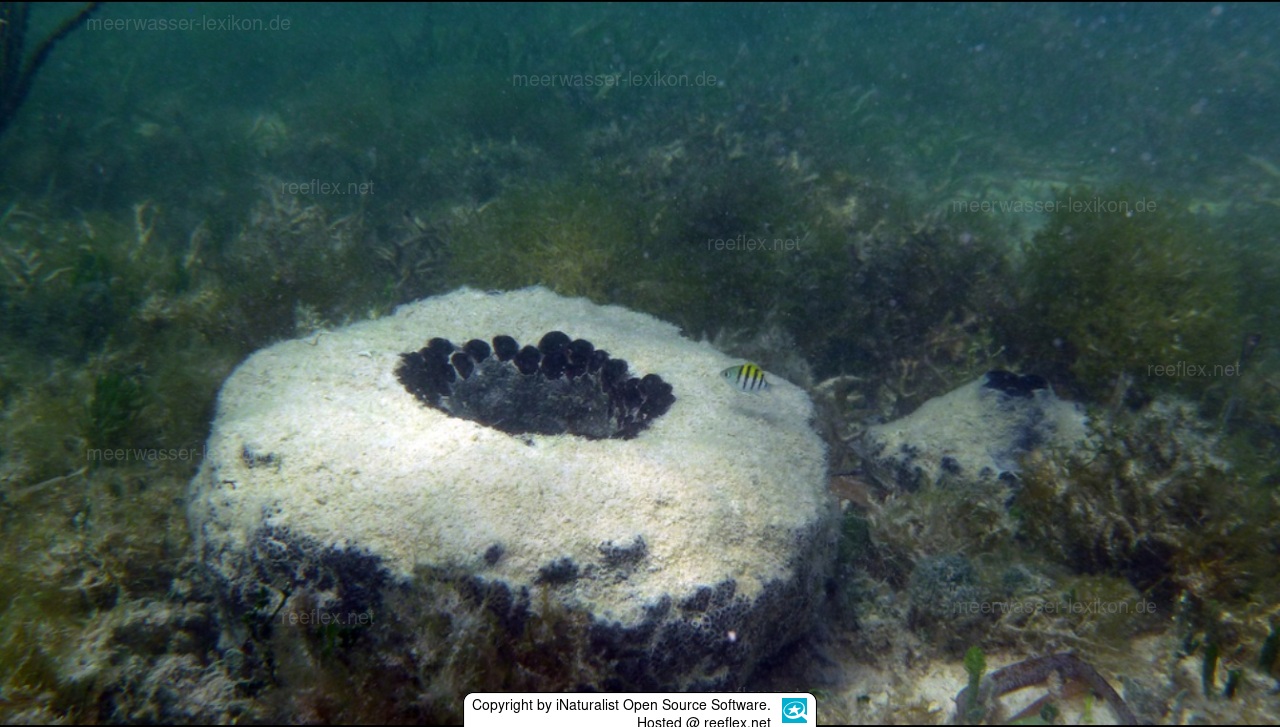
Spheciospongia vesparium occurs in black, anthracite, or dark gray, though it is often largely covered with light-colored sediment and algae growth.
The oscula are usually black; the inner color is identical.
The marine sponge forms large, broad, barrel-like shapes that can resemble a car tire; sometimes it can also be roughly spherical.
Regrowing, torn specimens can be highly irregular but retain a characteristic color, surface, and consistency.
In early growth stages, they excavate limestone and may appear as thick encrustations or low, massive mounds.
The surface of Spheciospongia vesparium is smooth, non-porous, with clusters of small inflow openings (pores), though sometimes irregularly rough.
Consistency: the tissue of the marine sponge is firm and only slightly compressible.
Spheciospongia vesparium is commonly found on hard, nearshore, shallow bottoms and in seagrass beds, less frequently on shallow reefs.
The marine sponge’s internal canal system harbors a rich, diverse fauna of invertebrates, including snapping shrimp (Alpheidae), amphipods, ophiuroids, and polychaetes.
Water pulses generated by snapping shrimp push small sediment clouds outward through pore sieves, which may contribute to the maintenance of the canal system.
At extremely low tide and in calm seas, the outflow from the flattest sponges can disturb the sea surface.
Synonyms:
Alcyonium vesparium Lamarck, 1815 · unaccepted (genus transfer)
Cliona cribrosa (Schmidt, 1870) · unaccepted (genus transfer & junior synonym)
Heterocliona cribraria Verrill, 1907 · unaccepted (genus transfer and junior synonym)
Hymeniacidon pulvinatus Bowerbank, 1872 · unaccepted (genus transfer & junior synonym)
Papillina cribrosa Schmidt, 1870 · unaccepted (genus transfer & junior synonym)
Poterion atlantica George & Wilson, 1919 · unaccepted (genus transfer & junior synonym)
Prianos tierneyi de Laubenfels, 1953 · unaccepted (genus transfer & junior synonym)
Pseudosuberites melanos de Laubenfels, 1934 · unaccepted (genus transfer & junior synonym)
Spheciospongia othello de Laubenfels, 1950 · unaccepted (junior synonym)
Spheciospongia vesparia · unaccepted (misspelling of species name)
Spheciospongia vesparium typica Vicente, Rützler & Carballeira, 1991 · unaccepted (junior synonym)
Spirastrella andrewsi George & Wilson, 1919 · unaccepted (genus transfer & junior synonym)
Spirastrella pulvinata (Bowerbank, 1872) · unaccepted (genus transfer & junior synonym)
Spongia dysoni Carter, 1882 · unaccepted (genus transfer & junior synonym)
Thalysias vesparia (Lamarck, 1814) · unaccepted (genus transfer)
For example, a 1-kg loggerhead sponge (Speciospongia vesparium) can filter 24,000 liters of water daily (Vogel, 1994) or 50,000 times its tissue volume (Reiswig, 1971), removing 6% of the DOM in seawater in the process (Letourneau et al., 2020).
Spheciospongia vesparium is one of the marine sponges with the highest biomass of all sponge species in the waters around Florida, and is capable of filtering 24,000 liters of seawater per day—a feat that very few people are even aware of.
To offer a comparison:
An 8 x 3-meter pool, commonly installed in larger gardens, can hold 30,000 liters of water, so our marine sponge is almost capable of filtering this entire pool every day!
Spheciospongia vesparium occurs in black, anthracite, or dark gray, though it is often largely covered with light-colored sediment and algae growth.
The oscula are usually black; the inner color is identical.
The marine sponge forms large, broad, barrel-like shapes that can resemble a car tire; sometimes it can also be roughly spherical.
Regrowing, torn specimens can be highly irregular but retain a characteristic color, surface, and consistency.
In early growth stages, they excavate limestone and may appear as thick encrustations or low, massive mounds.
The surface of Spheciospongia vesparium is smooth, non-porous, with clusters of small inflow openings (pores), though sometimes irregularly rough.
Consistency: the tissue of the marine sponge is firm and only slightly compressible.
Spheciospongia vesparium is commonly found on hard, nearshore, shallow bottoms and in seagrass beds, less frequently on shallow reefs.
The marine sponge’s internal canal system harbors a rich, diverse fauna of invertebrates, including snapping shrimp (Alpheidae), amphipods, ophiuroids, and polychaetes.
Water pulses generated by snapping shrimp push small sediment clouds outward through pore sieves, which may contribute to the maintenance of the canal system.
At extremely low tide and in calm seas, the outflow from the flattest sponges can disturb the sea surface.
Synonyms:
Alcyonium vesparium Lamarck, 1815 · unaccepted (genus transfer)
Cliona cribrosa (Schmidt, 1870) · unaccepted (genus transfer & junior synonym)
Heterocliona cribraria Verrill, 1907 · unaccepted (genus transfer and junior synonym)
Hymeniacidon pulvinatus Bowerbank, 1872 · unaccepted (genus transfer & junior synonym)
Papillina cribrosa Schmidt, 1870 · unaccepted (genus transfer & junior synonym)
Poterion atlantica George & Wilson, 1919 · unaccepted (genus transfer & junior synonym)
Prianos tierneyi de Laubenfels, 1953 · unaccepted (genus transfer & junior synonym)
Pseudosuberites melanos de Laubenfels, 1934 · unaccepted (genus transfer & junior synonym)
Spheciospongia othello de Laubenfels, 1950 · unaccepted (junior synonym)
Spheciospongia vesparia · unaccepted (misspelling of species name)
Spheciospongia vesparium typica Vicente, Rützler & Carballeira, 1991 · unaccepted (junior synonym)
Spirastrella andrewsi George & Wilson, 1919 · unaccepted (genus transfer & junior synonym)
Spirastrella pulvinata (Bowerbank, 1872) · unaccepted (genus transfer & junior synonym)
Spongia dysoni Carter, 1882 · unaccepted (genus transfer & junior synonym)
Thalysias vesparia (Lamarck, 1814) · unaccepted (genus transfer)

