




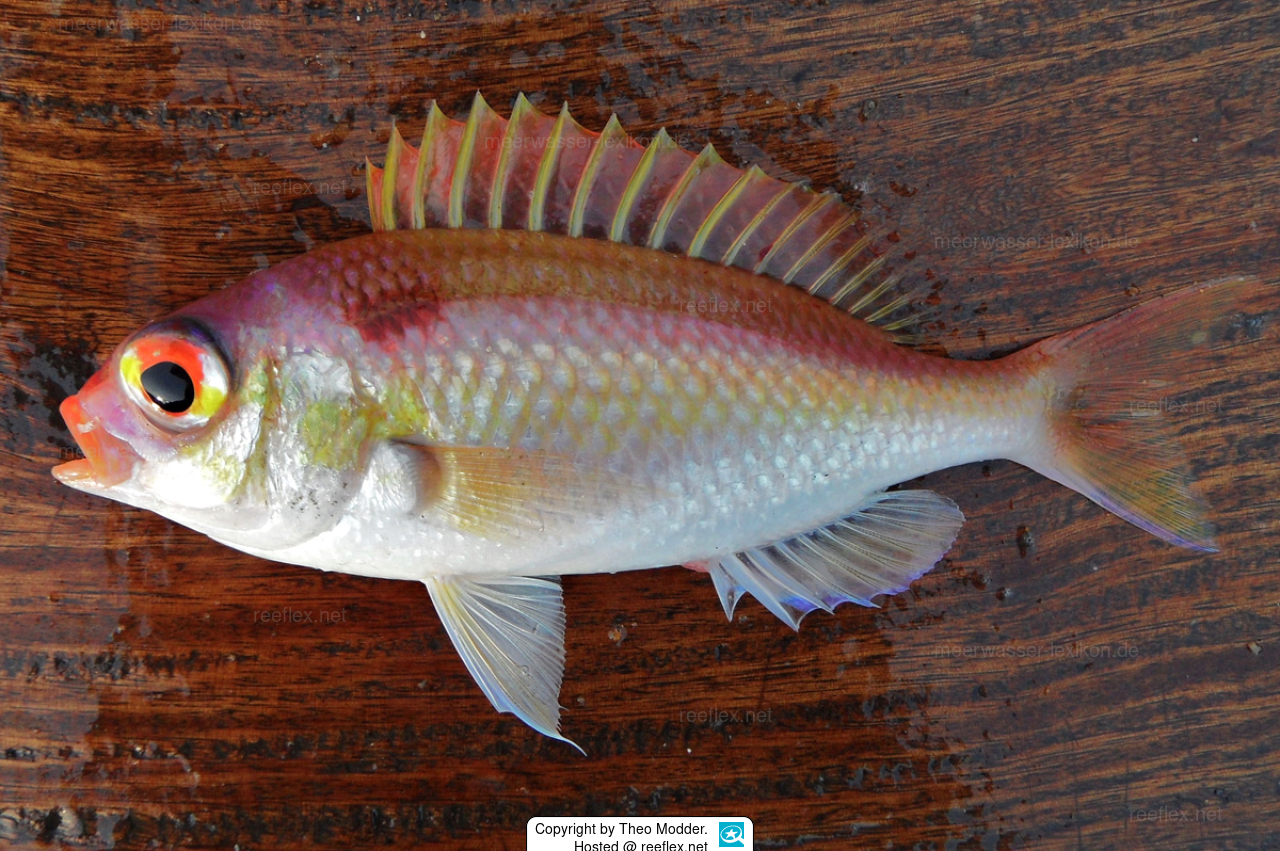
 Theo Modder, Niederlande


Info
This species inhabits coastal waters with sandy or muddy bottoms and is considered a sedentary species.
Description:
The body is generally reddish, darker on the back and lighter on the belly.
The iris is red or orange; three pale yellow stripes are visible on the head:
1) from the tip of the jaw to the lower part of the cheek
2) from the lower edge of the eye to the rear edge of the preoperculum
3) from the rear edge of the eye to the base of the pectoral fin; a pale yellow stripe runs along the midline of the trunk and tail
A dark red saddle, larger than the eye, is present at the base of the dorsal fin (indistinct or absent in large specimens).
A small black spot is located on the upper part of the pectoral fin base.
The dorsal fin is predominantly yellow in small specimens and red in large specimens.
Red, worm-like patterns are visible on the fin membrane in small specimens.
The pectoral, anal, and caudal fins are light yellow, while the caudal fin is predominantly yellow with indistinct red, worm-like patterns on the forked portion.
Etymology:
Parascolopsis eriomma was long confused with Parascolopsis eriomma.
Parascolopsis eriomma has a wider distribution than Parascolopsis eriomma and is more commonly found, at least in Japan and Taiwan (Hung et al. 2016).
Therefore, the English name “Rosy dwarf monocle bream” and the Japanese name “Aka-tamagashira,” which were previously used for Parascolopsis eriomma, are more appropriate for the new species to avoid unnecessary confusion.
The species name “akatamae” is derived from the local name of the type locality in Japan.
We would like to express our sincere thanks to Theo Modder of the Netherlands for the first photograph of this species.
Synonyms:
Prascolopsis arioma (Jordan & Richardson, 1909) · unaccepted (misspelling)
Scolopsis eriomma Jordan & Richardson, 1909 · unaccepted
Description:
The body is generally reddish, darker on the back and lighter on the belly.
The iris is red or orange; three pale yellow stripes are visible on the head:
1) from the tip of the jaw to the lower part of the cheek
2) from the lower edge of the eye to the rear edge of the preoperculum
3) from the rear edge of the eye to the base of the pectoral fin; a pale yellow stripe runs along the midline of the trunk and tail
A dark red saddle, larger than the eye, is present at the base of the dorsal fin (indistinct or absent in large specimens).
A small black spot is located on the upper part of the pectoral fin base.
The dorsal fin is predominantly yellow in small specimens and red in large specimens.
Red, worm-like patterns are visible on the fin membrane in small specimens.
The pectoral, anal, and caudal fins are light yellow, while the caudal fin is predominantly yellow with indistinct red, worm-like patterns on the forked portion.
Etymology:
Parascolopsis eriomma was long confused with Parascolopsis eriomma.
Parascolopsis eriomma has a wider distribution than Parascolopsis eriomma and is more commonly found, at least in Japan and Taiwan (Hung et al. 2016).
Therefore, the English name “Rosy dwarf monocle bream” and the Japanese name “Aka-tamagashira,” which were previously used for Parascolopsis eriomma, are more appropriate for the new species to avoid unnecessary confusion.
The species name “akatamae” is derived from the local name of the type locality in Japan.
We would like to express our sincere thanks to Theo Modder of the Netherlands for the first photograph of this species.
Synonyms:
Prascolopsis arioma (Jordan & Richardson, 1909) · unaccepted (misspelling)
Scolopsis eriomma Jordan & Richardson, 1909 · unaccepted

