Anzeige
Fauna Marin GmbH Tunze Tropic Marin OMega Vital Fauna Marin GmbH Aqua Medic

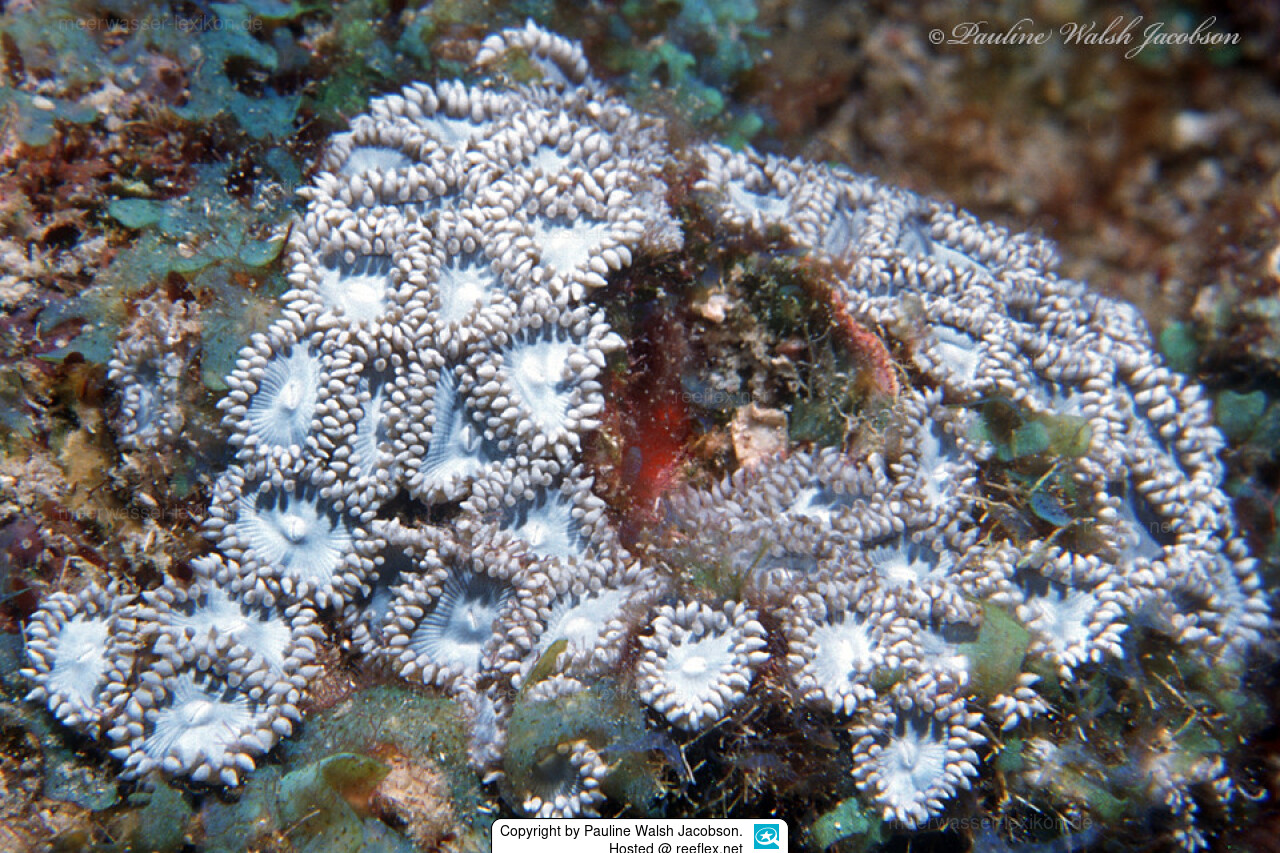
Zoanthus pulchellus Sea Mats, Mat Zoanthids

Zoanthus pulchellus is commonly referred to as Sea Mats, Mat Zoanthids. Difficulty in the aquarium: facile. A aquarium size of at least 100 Liter is recommended. Toxicity: Has a poison harmful to health.


Profilbild Urheber Pauline Walsh Jacobson, USA

Mat Zoanthids, Zoanthus pulchellus, The Steps, 2022


Courtesy of the author Pauline Walsh Jacobson, USA Pauline Walsh Jacobson, USA. Please visit www.flickr.com for more information.

Uploaded by Muelly.

Image detail


Profile

lexID:
2164 
AphiaID:
288840 
Scientific:
Zoanthus pulchellus 
German:
Matten-Krustenanemone 
English:
Sea Mats, Mat Zoanthids 
Category:
Anémones coloniales 
Family tree:
Animalia (Kingdom) > Cnidaria (Phylum) > Anthozoa (Class) > Zoantharia (Order) > Zoanthidae (Family) > Zoanthus (Genus) > pulchellus (Species) 
Initial determination:
(Duchassaing & Michelotti, ), 1860 
Occurrence:
Belize, Bonaire, Canada Eastern Pacific, Costa Rica, Florida, Gulf of Mexico, India, Indian Ocean, The Bahamas, the Caribbean, the Netherlands Antilles 
Marine Zone:
Subtidal, sublittoral, infralittoral, deep zone of the oceans from the lower limit of the intertidal zone (intertidal) to the shelf edge at about 200 m water depth. neritic. 
Sea depth:
0 - 24 Meter 
Size:
0" - 0.51" (0,3cm - 1.3cm) 
Temperature:
71.6 °F - 84.2 °F (22°C - 29°C) 
Food:
Brine Shrimp Nauplii, Copepods, Plankton, Zooxanthellae / Light 
Tank:
22 gal (~ 100L)  
Difficulty:
facile 
Offspring:
Possible to breed 
Toxicity:
Has a poison harmful to health 
CITES:
Not evaluated 
Red List:
Least concern (LC)  
Related species at
Catalog of Life
:
 
More related species
in this lexicon
:
 
Author:
Publisher:
Meerwasser-Lexikon.de
Created:
Last edit:
2023-03-26 18:46:37 

Élevages

Des élevages de Zoanthus pulchellus sont possibles. Malheureusement il y en a pas assez pour le commerce. Si vous vous intéressez pour Zoanthus pulchellus demandez a votre commerçant du élevage. Si vous avez déjà Zoanthus pulchellus essayez vous même de faire un élevage! Vous pourriez aider au commerce et de protéger la nature.

Poison

Attention! Zoanthus pulchellus possède un venin nocif pour votre santé. Normalement les espèces de cette catégorie n’émettent pas de danger pour vous. Lisez bien les informations et les commentaires des utilisateurs qui possèdent Zoanthus pulchellus pour pouvoir mieux évaluer une possibilité de danger. Soyez prudents avec Zoanthus pulchellus. Chaque humain réagit différemment sur des venins. Si vous pensez d'avoir été en contact avec le venin consultez un médecin ou un centre antipoison. Le numéro des centres A
s
antipoison sont trouvables ici: European Association of Poisons Centres and Clinical Toxicologists

Info

Zoanthus pulchellus (Duchassaing & Michelotti, 1860)

This mat zoanthids can be found around the Tropical Western Atlantic Ocean: Caribbean, and the Bahamas. Inhabits rubble, rocky areas and reef flat surfaces in coastal bays and lagoons near the surfaces experiencing wave action.

Synonymised names:
Zoanthus anduzii (Duchassaing & Michelotti, 1860)
Zoanthus auricula (Lesueur, 1817)
Zoanthus nymphaeus (Lesueur, 1817)
Korallenriff Magazin

Cover Korallenriff Magazin Ausgabe 7

Ausgabe #7
Mithra­culus sculptus

Die grüne Spinnenkrabbe Mithra­culus sculptus ist eine kleinbleibende Krabbe die häufig zur Kontrolle unerwünschter Algen, insbesondere Kugelalgen angeboten wird..

Weiterlesen


Pictures

Commonly


Husbandry know-how of owners

am 24.05.09#2
Ich muß hier meinem "Vor-Schreiber" widersprechen. Bei mir breitet sich diese Art ziemlich heftig im Becken aus und wollte daher dieser mal ein wenig Einhalt gebieten.
Schon kurz nach dem Hantieren verspürte ich ein deutliches Unwohlsein. Ca. 1h später hatte ich einen aufdringlichen metallischen Geschmack im Mund - alles was ich zu mir genommen hatte, egal ob fest oder flüssig schmeckte wie Aluminiumpapier. Das sind ganz deutliche Anzeichen einer Vergiftung! Die Nacht drauf hatte ich sodann auch die bekannten Grippe-Erscheinungen wie Schleim im Hals, Kalt-Heiß-Phasen und einen "dicken" Kopf.
Erst ca. 24h später sind diese Symptome abgeklungen. Das ist nun schon das zweite mal wo mir das passiert. Ich werde sicherlich beim nächsten mal Handschuhe tragen!
am 29.07.07#1
Da es sich hier um eine Zoanthus Spezies handelt, denke ich, dass hier die Giftigkeit nicht so vorliegt wie beschrieben.
Diese Art war irrtümlich als Palyathoa im Meerwasserlexikon eingestellt, daher der Hinweis mit der Giftigkeit.
2 husbandary tips from our users available
Show all and discuss