Anzeige
Fauna Marin GmbH Mrutzek Meeresaquaristik Osci Motion Aqua Medic Fauna Marin GmbH

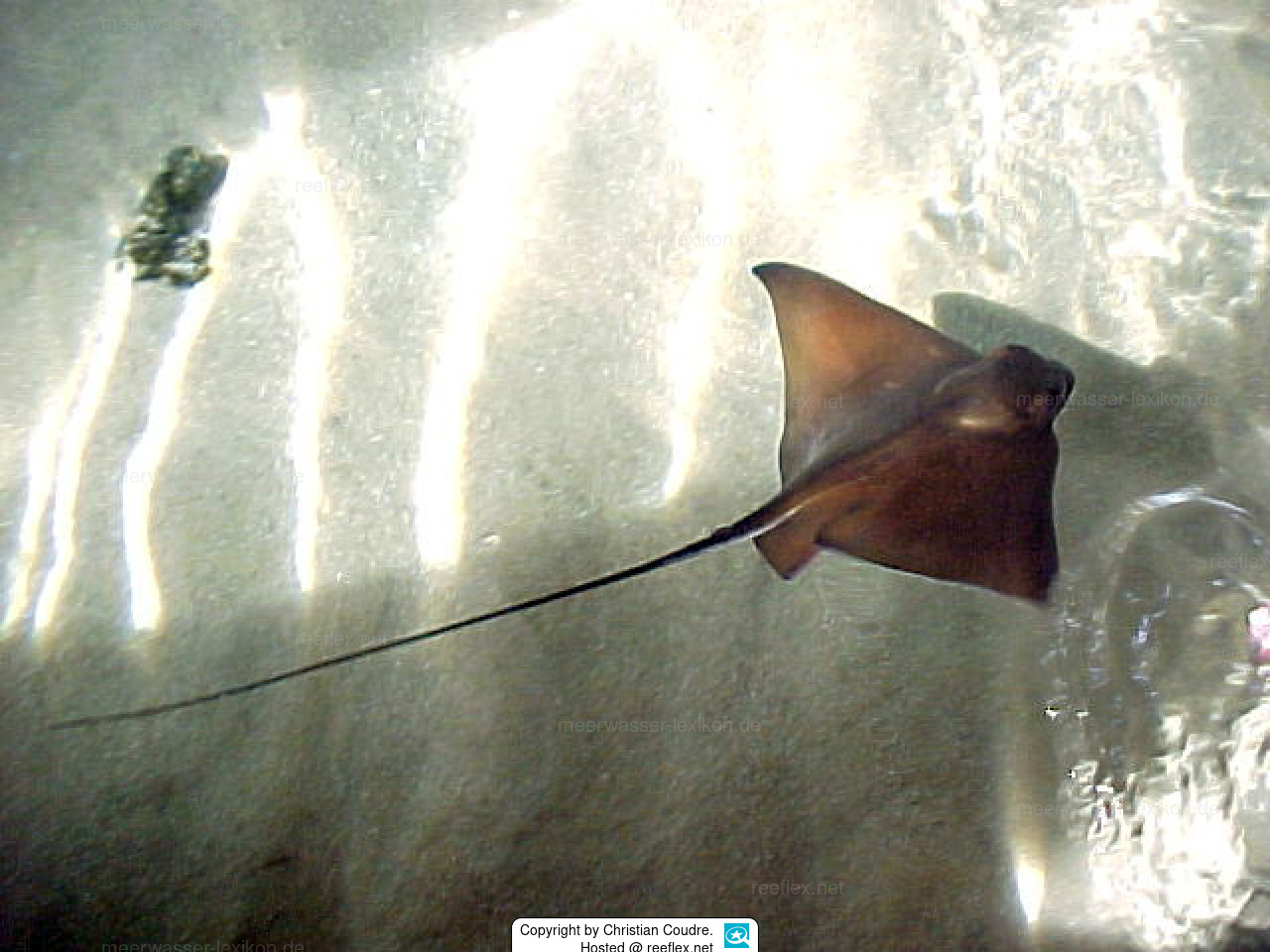
Myliobatis aquila Common eagle ray

Myliobatis aquila is commonly referred to as Common eagle ray. Difficulty in the aquarium: Pas pour l'aquarium!. Toxicity: Has a poison harmful to health.


Profilbild Urheber Christian Coudre, Frankreich

copyright Christian Coudre, Frankeich


Courtesy of the author Christian Coudre, Frankreich Copyright Christian Coudre. Please visit www.cotebleue.org for more information.

Uploaded by AndiV.

Image detail


Profile

lexID:
4703 
AphiaID:
105860 
Scientific:
Myliobatis aquila 
German:
Gewöhnlicher Adlerrochen 
English:
Common Eagle Ray 
Category:
Raies 
Family tree:
Animalia (Kingdom) > Chordata (Phylum) > Elasmobranchii (Class) > Myliobatiformes (Order) > Myliobatidae (Family) > Myliobatis (Genus) > aquila (Species) 
Initial determination:
(Linnaeus, ), 1758 
Occurrence:
Ghana, Straße von Gibraltar, the Black Sea, the North Sea, Angola, Azores, Cameroon, Congo, East-Atlantic Ocean, Egypt, Equatorial Guinea, European Coasts, Madagascar, Madeira, Namibia, Nigeria, Northern Africa, Portugal, Réunion , São Tomé e Principé, Scandinavia, Senegal, Sierra Leone, South-Africa, Spain, the Canary Islands, the Isle of Man, the Ivory Coast, the Mediterranean Sea, Togo, West Africa 
Size:
43.31" - 86.61" (110cm - 220cm) 
Temperature:
60.8 °F - 78.8 °F (16°C - 26°C) 
Food:
Clams, Crabs, Crustaceans, Edible crab, Fish (little fishes), Flatfish, Invertebrates, Lobster, Mysis, Predatory, Rock lobster, Schrimps, Sea squirts, Sepia, Snails, Worms, Zoobenthos 
Difficulty:
Pas pour l'aquarium! 
Toxicity:
Has a poison harmful to health 
CITES:
Not evaluated 
Related species at
Catalog of Life
:
 
Author:
Publisher:
Meerwasser-Lexikon.de
Created:
Last edit:
2012-10-09 13:56:30 

Poison

Attention! Myliobatis aquila possède un venin nocif pour votre santé. Normalement les espèces de cette catégorie n’émettent pas de danger pour vous. Lisez bien les informations et les commentaires des utilisateurs qui possèdent Myliobatis aquila pour pouvoir mieux évaluer une possibilité de danger. Soyez prudents avec Myliobatis aquila. Chaque humain réagit différemment sur des venins. Si vous pensez d'avoir été en contact avec le venin consultez un médecin ou un centre antipoison. Le numéro des centres A
s
antipoison sont trouvables ici: European Association of Poisons Centres and Clinical Toxicologists

Info

(Linnaeus, 1758)

Distribution:
Eastern Atlantic: Madeira, Morocco and the Canary Islands north to the western coasts of Ireland and British Isles and the southwestern North Sea, south to Natal, South Africa.
Also throughout the Mediterranean.

Biology:
Found in shallow lagoons, bays and estuaries; also offshore down to at least 95 m.
Often found in groups.
Feeds on benthic crustaceans, mollusks and fish.
Ovoviviparous (Ref. 50449).
Gestation period of 6-8 months, the females give birth to 3-7 young.
Caught by shore and ski-boat anglers, usually released after capture.
Flesh is highly esteemed.
Sportfish:

Synonymised taxa:
Leiobatus aquila (Linnaeus, 1758)
Myliobatis cervus Smith, 1935
Myliobatis equila (Linnaeus, 1758) (misspelling)
Myliobatis noctula Bonaparte, 1833
Myliobatus aquila (Linnaeus, 1758) (misspelling)
Raia rhombus Larrañaga, 1923
Raja aquila Linnaeus, 1758 We

External links

  1. FishBase (multi). Abgerufen am 07.08.2020.
  2. Homepage Prof. Dr. Peter Wirtz (en) (Archive.org). Abgerufen am 07.08.2020.
  3. IUCN Red List of Threatened Species (multi). Abgerufen am 07.08.2020.
  4. World Register of Marine Species (WoRMS) (en). Abgerufen am 07.08.2020.

Pictures

Commonly

copyright Christian Coudre, Frankeich
1
copyright Christian Coudre, Frankeich
1
copyright Dr. Peter Wirtz
1

Husbandry know-how of owners

0 husbandary tips from our users available
Show all and discuss