

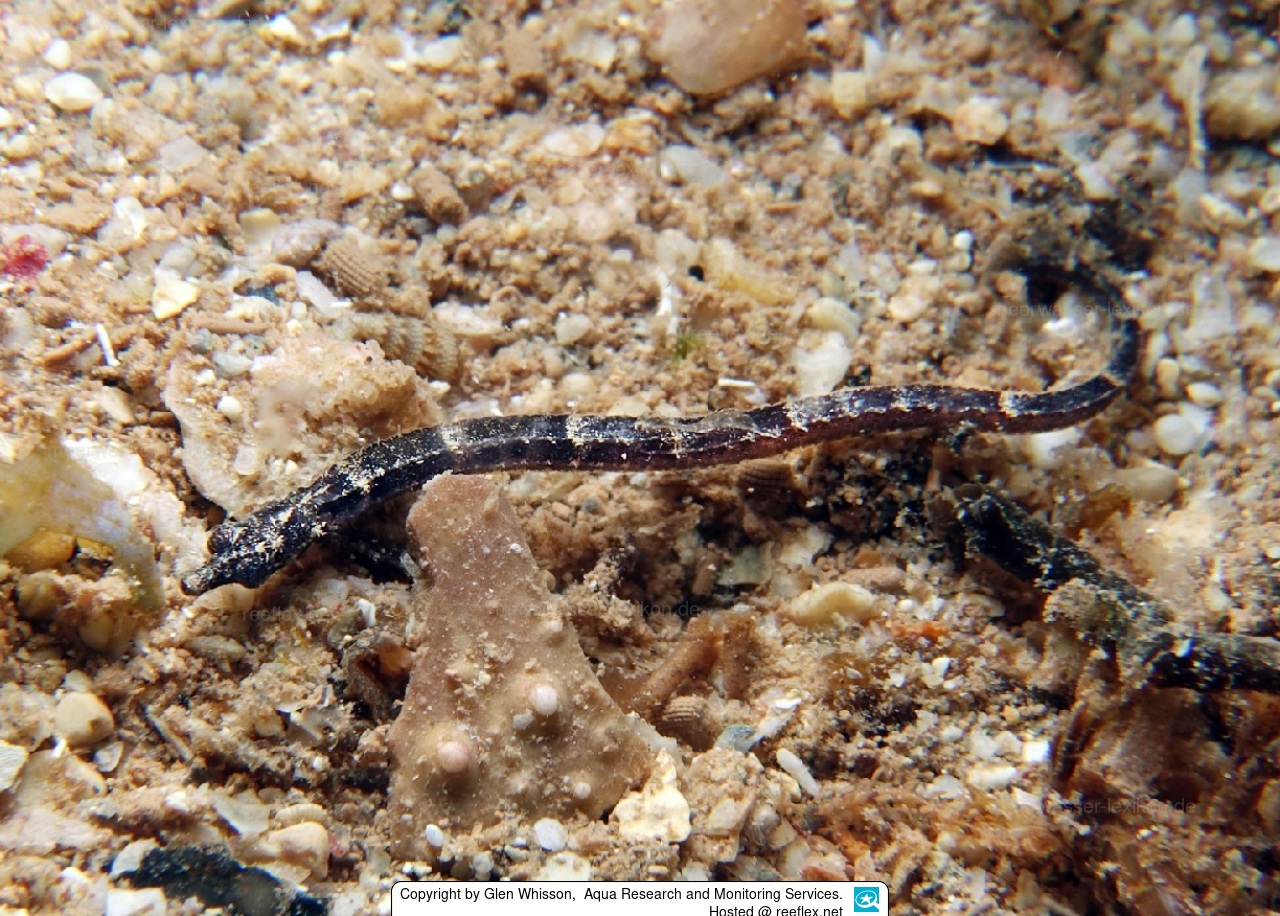
 Dr. Glen Whisson, Aqua Research and Monitoring Services, Australien


Info
Micrognathus micronotopterus is a small pipefish commonly found in tidal pools on coral reefs, on shallow coral reef plateaus, and in seagrass beds.
The pipefish is light to dark brown, usually mottled, and has 10–12 narrow, light-colored stripes running across its back.
Sometimes with dark stripes running down the lower part of the sides and the ventral side of the body.
Micrognathus micronotopterus differs from other species in this genus by typically having 15 body rings, a relatively long snout, and predominantly straight caudal ribs.
The skin flaps on the head are generally long and simple, in contrast to the shorter, curled, or branched skin flaps of adult individuals of other Micrognathus species.
Brief description:
The body is slender and elongated; head length accounts for 7.2–8.9% of standard length (SL).
The snout length accounts for 2.3–3.0% of the head length; the upper body and tail crests are interrupted, and the lower body crest ends at the anal ring.
The lateral body crest merges into the lower tail crest; the median dorsal snout crest is low, continuous, and slightly concave in lateral view.
The longitudinal ridge on the gill cover is complete in juveniles, incomplete to vestigial in subadults and adults.
Head and body rings lack spines, teeth, or serrations.
The origin of the dorsal fin lies between the anterior margin of the penultimate body ring and the posterior margin of the first caudal ring; the fin base is not distinctly elevated in subadult and adult individuals.
Etymology:
The genus name “Micrognathus” is derived from the Greek “micro” for small and “gnathos” for jaw and refers to the short snout of this species.
The species name “micronotopterus” comes from Greek and means “small dorsal fin.”
Synonyms:
Syngnathus micronotopterus Fowler, 1938
Syngnathus micronotopterus Fowler, 1938 · unaccepted
We would like to extend our sincere thanks to Glen Whisson for the first photo of this species!
The pipefish is light to dark brown, usually mottled, and has 10–12 narrow, light-colored stripes running across its back.
Sometimes with dark stripes running down the lower part of the sides and the ventral side of the body.
Micrognathus micronotopterus differs from other species in this genus by typically having 15 body rings, a relatively long snout, and predominantly straight caudal ribs.
The skin flaps on the head are generally long and simple, in contrast to the shorter, curled, or branched skin flaps of adult individuals of other Micrognathus species.
Brief description:
The body is slender and elongated; head length accounts for 7.2–8.9% of standard length (SL).
The snout length accounts for 2.3–3.0% of the head length; the upper body and tail crests are interrupted, and the lower body crest ends at the anal ring.
The lateral body crest merges into the lower tail crest; the median dorsal snout crest is low, continuous, and slightly concave in lateral view.
The longitudinal ridge on the gill cover is complete in juveniles, incomplete to vestigial in subadults and adults.
Head and body rings lack spines, teeth, or serrations.
The origin of the dorsal fin lies between the anterior margin of the penultimate body ring and the posterior margin of the first caudal ring; the fin base is not distinctly elevated in subadult and adult individuals.
Etymology:
The genus name “Micrognathus” is derived from the Greek “micro” for small and “gnathos” for jaw and refers to the short snout of this species.
The species name “micronotopterus” comes from Greek and means “small dorsal fin.”
Synonyms:
Syngnathus micronotopterus Fowler, 1938
Syngnathus micronotopterus Fowler, 1938 · unaccepted
We would like to extend our sincere thanks to Glen Whisson for the first photo of this species!

