





 Dr. Juri Hooker, Peru


Info
The beaked bass Oplegnathus insignis is typically a solitary fish and constantly swims over rocky reefs and slopes strewn with boulders, as well as along steep walls in shallow waters.
Adult fish are black with numerous white spots that often merge into an irregular labyrinth-like pattern.
The lower jaw, chest, and belly are white.
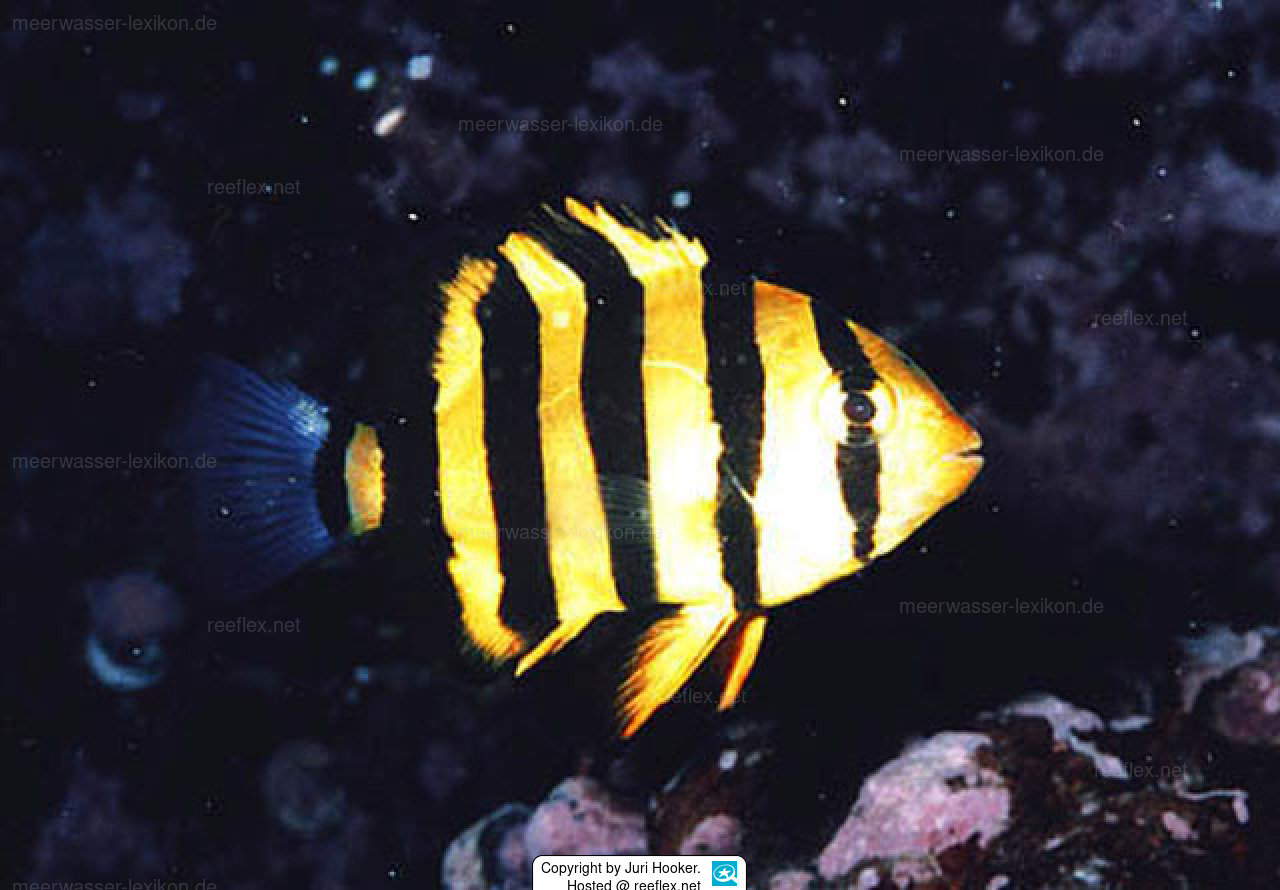
Juvenile bass are yellow with six black stripes—one above the eye, four along the body, and one at the base of the caudal fin.
In semi-adult animals, the yellow-colored body stripes feature a striped pattern.
The body of Oplegnathus insignis appears laterally compressed, and the mouth is small.
The teeth in the jaws are fused into a parrot-like beak (hence the name “beaked perch”), with a median suture in each jaw and 17 gill rakers.
The edge of the preoperculum is finely serrated.
Oplegnathus insignis has a continuous dorsal fin; the soft portion of the dorsal and anal fins is high and triangular;
the caudal fin has a straight edge with very small scales, about 115–130 in the middle lateral row.
The lateral line is strongly arched.
Synonym: Scarostoma insigne Kner, 1867 · unaccepted
Adult fish are black with numerous white spots that often merge into an irregular labyrinth-like pattern.
The lower jaw, chest, and belly are white.
Juvenile bass are yellow with six black stripes—one above the eye, four along the body, and one at the base of the caudal fin.
In semi-adult animals, the yellow-colored body stripes feature a striped pattern.
The body of Oplegnathus insignis appears laterally compressed, and the mouth is small.
The teeth in the jaws are fused into a parrot-like beak (hence the name “beaked perch”), with a median suture in each jaw and 17 gill rakers.
The edge of the preoperculum is finely serrated.
Oplegnathus insignis has a continuous dorsal fin; the soft portion of the dorsal and anal fins is high and triangular;
the caudal fin has a straight edge with very small scales, about 115–130 in the middle lateral row.
The lateral line is strongly arched.
Synonym: Scarostoma insigne Kner, 1867 · unaccepted


