




 Dr. Gerald (Gerry) Robert Allen, Australien


Info
Smith-Vaniz & Allen, 2011
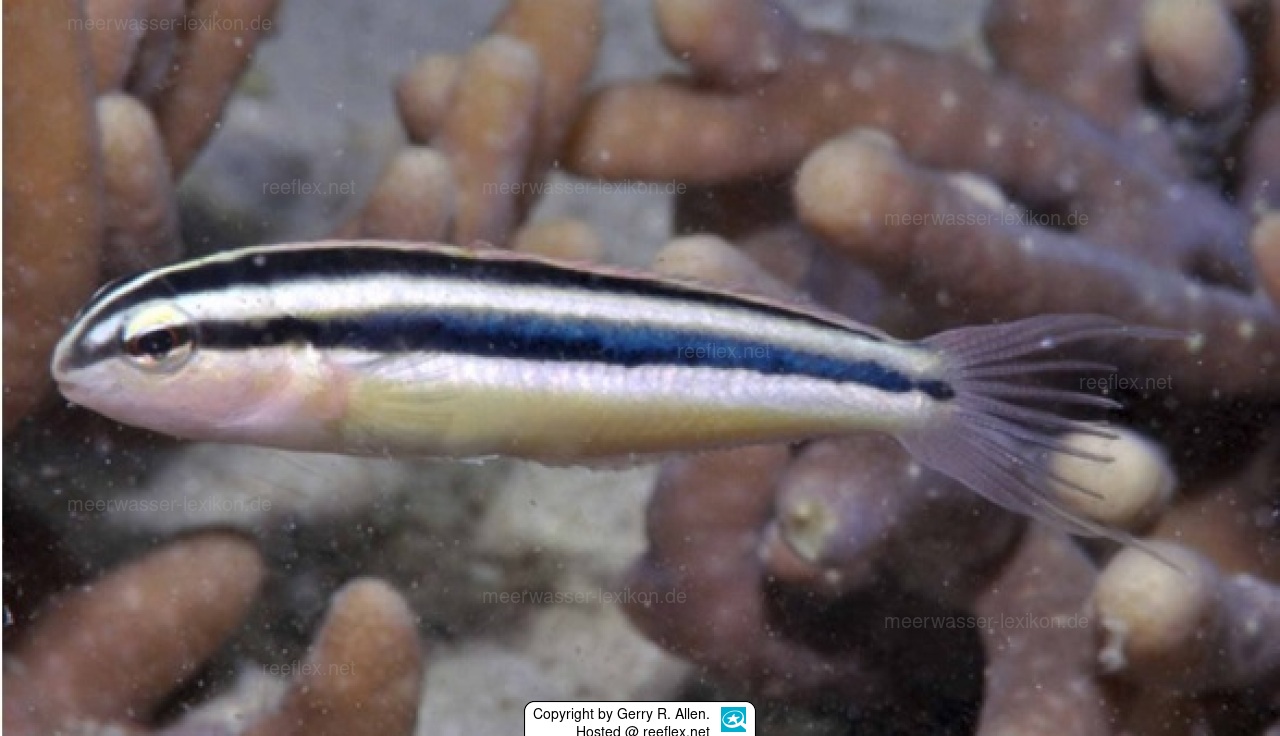
Very special thanks for the first wo photos of Meiacanthus abruptus to Dr. Gerry R. Allen from Australia.
The Komodo fangblenny is only known from Bali and Komodo Island, Indonesia, where it occurs in shallow, near-shore waters near coral and mangrove areas.
Classification: Biota > Animalia (Kingdom) > Chordata (Phylum) > Vertebrata (Subphylum) > Gnathostomata (Superclass) > Pisces (Superclass) > Actinopteri (Class) > Perciformes (Order) > Blennioidei (Suborder) > Blenniidae (Family) > Blenniinae (Subfamily) > Meiacanthus (Genus) > Meiacanthus abruptus (Species)
Jumping guard
A jumping guard prevents (nocturnal) fish from jumping out.
Wrasses, blennies, hawkfishs and gobies jump out of an unprotected tank in fright if their night rest is disturbed, unfortunately these jumpers are found dried up in the morning on carpets, glass edges or later behind the tank.
https://www.korallenriff.de/en/article/1925_5_Jump_Protection_Solutions_for_Fish_in_the_Aquarium__5_Net_Covers.html
A small night light also helps, as it provides the fish with a means of orientation in the dark!
Very special thanks for the first wo photos of Meiacanthus abruptus to Dr. Gerry R. Allen from Australia.
The Komodo fangblenny is only known from Bali and Komodo Island, Indonesia, where it occurs in shallow, near-shore waters near coral and mangrove areas.
Classification: Biota > Animalia (Kingdom) > Chordata (Phylum) > Vertebrata (Subphylum) > Gnathostomata (Superclass) > Pisces (Superclass) > Actinopteri (Class) > Perciformes (Order) > Blennioidei (Suborder) > Blenniidae (Family) > Blenniinae (Subfamily) > Meiacanthus (Genus) > Meiacanthus abruptus (Species)
Jumping guard
A jumping guard prevents (nocturnal) fish from jumping out.
Wrasses, blennies, hawkfishs and gobies jump out of an unprotected tank in fright if their night rest is disturbed, unfortunately these jumpers are found dried up in the morning on carpets, glass edges or later behind the tank.
https://www.korallenriff.de/en/article/1925_5_Jump_Protection_Solutions_for_Fish_in_the_Aquarium__5_Net_Covers.html
A small night light also helps, as it provides the fish with a means of orientation in the dark!


