robertbaur


Info
Waite, 1900
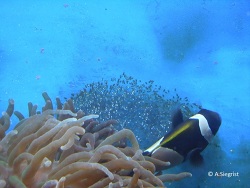
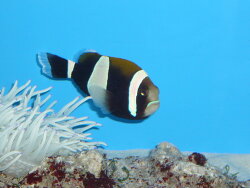
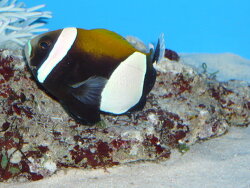
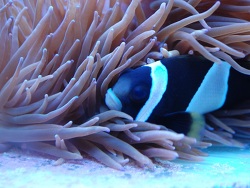
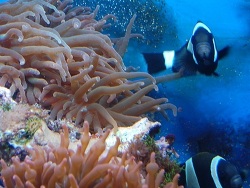
Associated with the anemone Radianthus crispa.
Sex and mating.
Anemonefish are protandrous hermaphrodites, meaning that life begins as a male. If two juveniles of the same size are present, then the more dominant anemonefish will develop into a female. If two females of the same size are placed together, then the weaker female will form back into the male, but this will take some time and there will be fierce fighting. The reversion can take several weeks, and during this time the more dominant female will keep putting the pressure on the weaker female until the sex has changed.
If there are several anemonefish in the aquarium and the dominant female dies, the previously dominant male will revert to female and a previously suppressed animal will move up to the dominant male. By this adjustment the main task, the spreading of the "own genes" on fast way remains.
Once the disputes have settled and the roles are established, the female will continue to grow. The difference in size from male to female is about 1-3 cm depending on the initial size of the species.
Associated with the anemone Radianthus crispa.
Sex and mating.
Anemonefish are protandrous hermaphrodites, meaning that life begins as a male. If two juveniles of the same size are present, then the more dominant anemonefish will develop into a female. If two females of the same size are placed together, then the weaker female will form back into the male, but this will take some time and there will be fierce fighting. The reversion can take several weeks, and during this time the more dominant female will keep putting the pressure on the weaker female until the sex has changed.
If there are several anemonefish in the aquarium and the dominant female dies, the previously dominant male will revert to female and a previously suppressed animal will move up to the dominant male. By this adjustment the main task, the spreading of the "own genes" on fast way remains.
Once the disputes have settled and the roles are established, the female will continue to grow. The difference in size from male to female is about 1-3 cm depending on the initial size of the species.